.tmb-small.jpg?Culture=en&sfvrsn=35155c48_1)
The Data Behind User Frustration
We’ve all been infuriated by apps, sites, and software. Frustration is so common, we expect it. We are resigned to it. Our team has seen this firsthand working with users for more than three decades. And we recently encountered an academic study that reinforces our observations.
In 2023, Danish researchers Morten Hertzeum and Kasper Hornbaek published a fascinating research article for the Association for Computing Machinery (ACM), “Frustration: Still a Common User Experience.” The piece lays bare the depressing state of our relationship with technology.
Hertzeum and Hornbaek asked 234 participants to log their everyday online experiences, noting specific episodes of exasperation. Based on the data, they concluded user frustration is a standard, demonstrable, dispiriting part of everyday life.
Once again, science has proven the obvious.
Frustrating Findings
Let’s hit the high (or rather low) points of the study:
- Frustration Is Common and Expected — 87% of participants experienced frustration while using technology, and they expected to be frustrated again in the future. Worse, 84% of incidents “were recurring problems.
- Frustration Wastes Significant Time — Participants in the study lost roughly six minutes per hour dealing with frustrating incidents. That works out to just under one hour per workday, an eye-popping finding.
- Top Sources of Frustration Are Performance, Utility, and Usability — People are massively irritated by slow products that don’t do what they need and are difficult to use.
- Issues Were Unresolved a Quarter of the Time — While most participants resolved frustrating incidents one way or another, 26% gave up or never resolved their problem.
This is just a brief taste of the study. The full details are even more bleak. We strongly recommend a full read. It is a must for anyone planning, making, or managing digital products.
Surveying Exasperation
The study’s conclusions didn’t shock us one bit. For years, we’ve watched users struggle. Still, we were intrigued by the data and wondered if a less formal study, done on the quick, would still echo a more academic study.
To this end, we created a simple online survey. We asked 276 people multiple-choice questions about their experiences with interactive technology. Our questions focused on whether and how digital products frustrated or delighted them.
The Survey
Our method was by no means rigorous. Though our questions were as neutral as we could manage, we had limited control over participant selection and knew we would gain only so much from a volunteer survey. But if our results came even somewhat close to the great Danes’ findings, we’d have even more confidence in their conclusions.
First, the basic information about our respondents, all of whom were from the United States:
Demographics
- 66% male
- 34% female
- 70% between the ages of 30–60
- 20% over 60
- 10% between the ages of 18–29
Experience with Interactive Technology
- 26% considered themselves inexperienced
- 29% considered themselves somewhat experienced to average
- 25% self-reported strong experience and high comfort level
- 20% considered themselves to be near experts with technology
Frequency Using Interactive Technology
- 65% reported multiple times a day
- 20% reported at least once a day.
- 10% reported several times a week
- 4% reported a few times a month to hardly ever
Our Findings
Unsurprisingly, our makeshift results closely paralleled the more formal Hertzeum Hornbaek findings.
Irritation is Ordinary
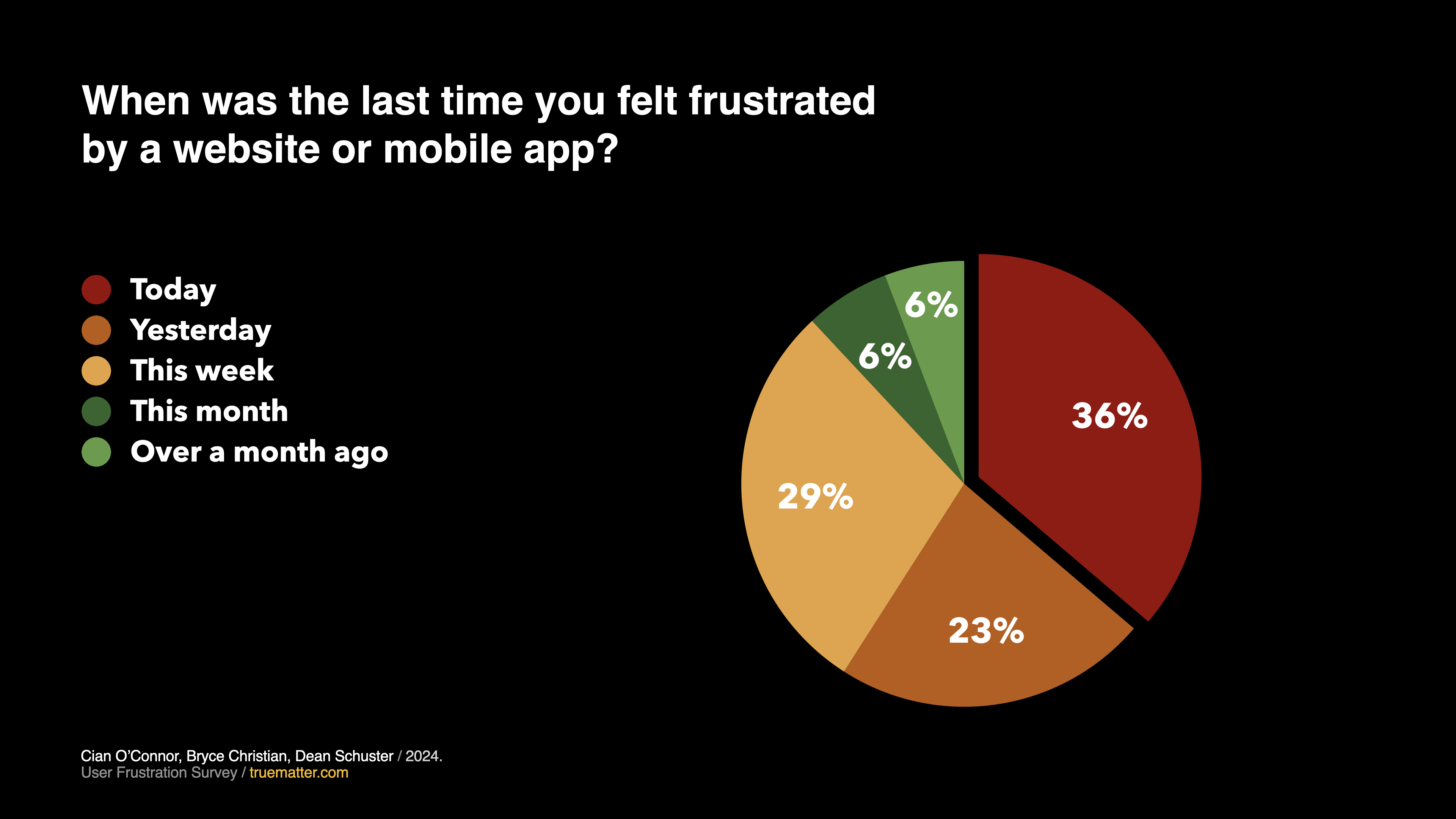
Our respondents noted significant frustration when using interactive technology. Roughly 36% reported same-day frustration. Almost 60% felt frustrated in the last 2 days. Combined, almost 90% reported feeling frustrated in the last week.
The Hertzeum Hornbaek study measured frustration more granularly, by the hour, but the essential conclusion is clear and emphatic. People are routinely frustrated with computers, sites, apps, and software.
What Drives People Crazy?
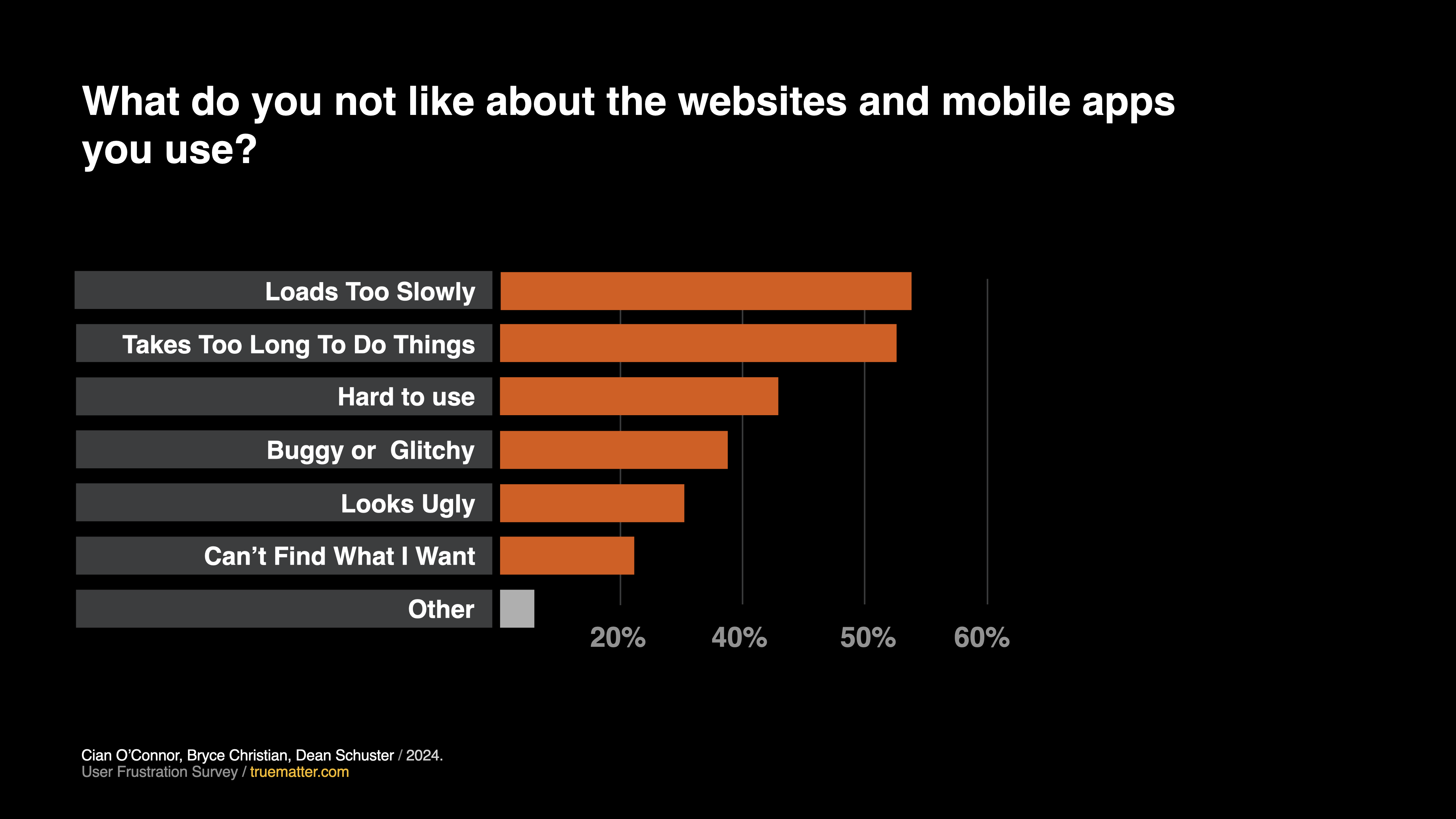
Over the years, we have heard people repeatedly complain about the same things. They hate wasting time and they despise technology that simply doesn’t work.
When a site loads slowly, they seethe with anger. When a supposedly simple task feels endless or overly difficult, their blood pressure rises. When an app is broken (or appears to be) people throw up their hands in disgust. Users are roundly frustrated and even enraged by digital products.
We are completely confident in this assessment based on decades of user observation, anecdotal reports across industries, years of studying behavior tracking reports (think “rage clicks”), and our understanding of the essential truths about users. The top nine sources of frustration identified by Hertzeum and Hornbaek confirm this pervasive problem, as does our little complimentary survey.
How Do People Deal with Frustration?
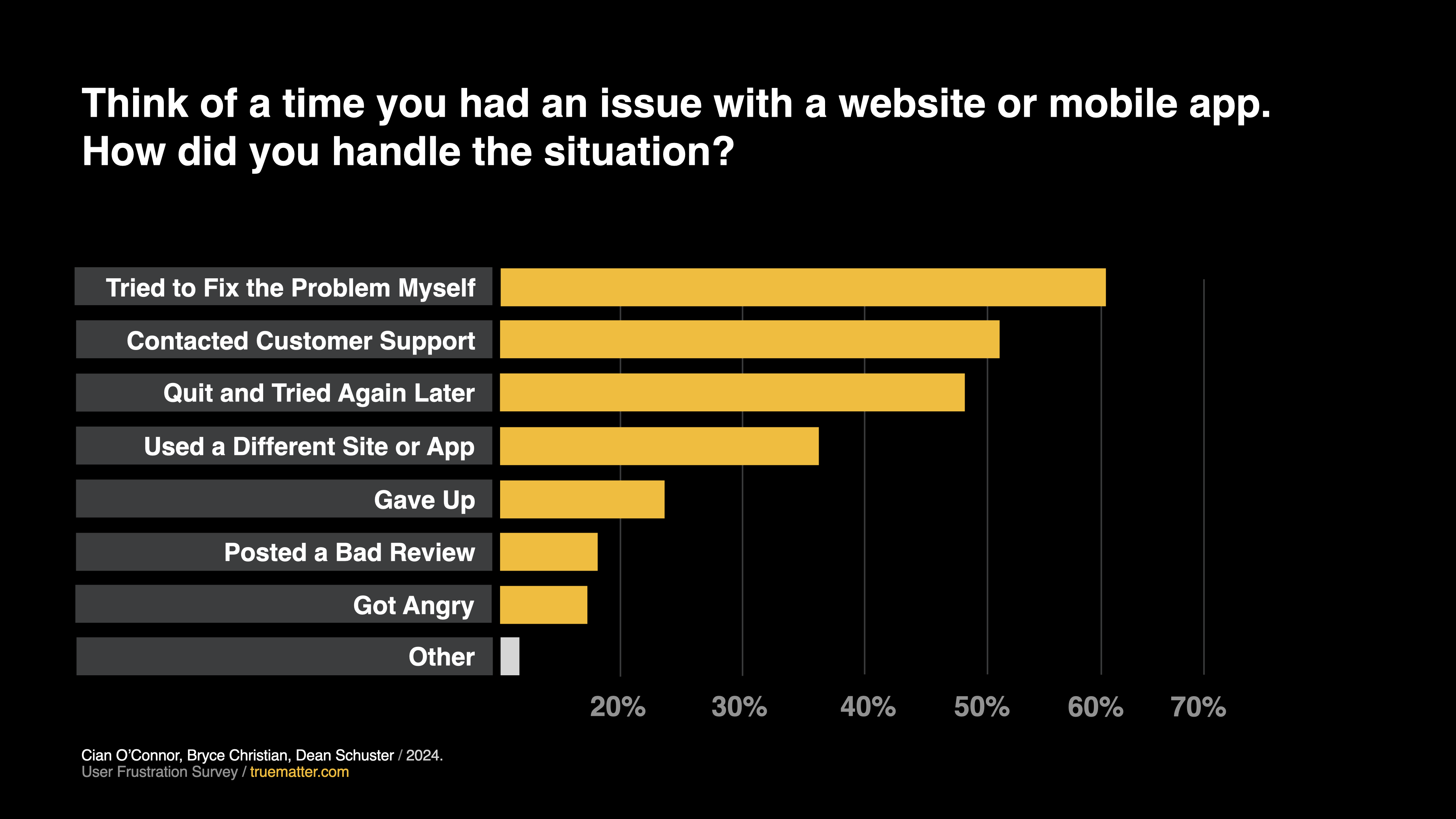
When something goes wrong, people must decide how to respond. Our survey found that users spend precious time trying to solve problems, either by themselves (60%), by contacting customer support (50%), or by simply quitting and trying again later (49%). Some users, a whopping 37%, said they would use a different website or app.
Of course, some people simply give up. Our survey showed that, when frustrated, 23% of users reported they would abandon their task completely.
This result was quite close to Hertzeum and Hornbaek’s findings. Their study showed that 26% of the time, users could not “resolve issues,” calling this a “disturbing” finding.
We agree but would go further. When a quarter of people can’t do what they want or need, it’s more than disturbing. It reveals a fundamental flaw in how digital products are made.
Do People Keep Using Frustrating Products?
The short answer is yes. Most people soldier on even when frustrated.
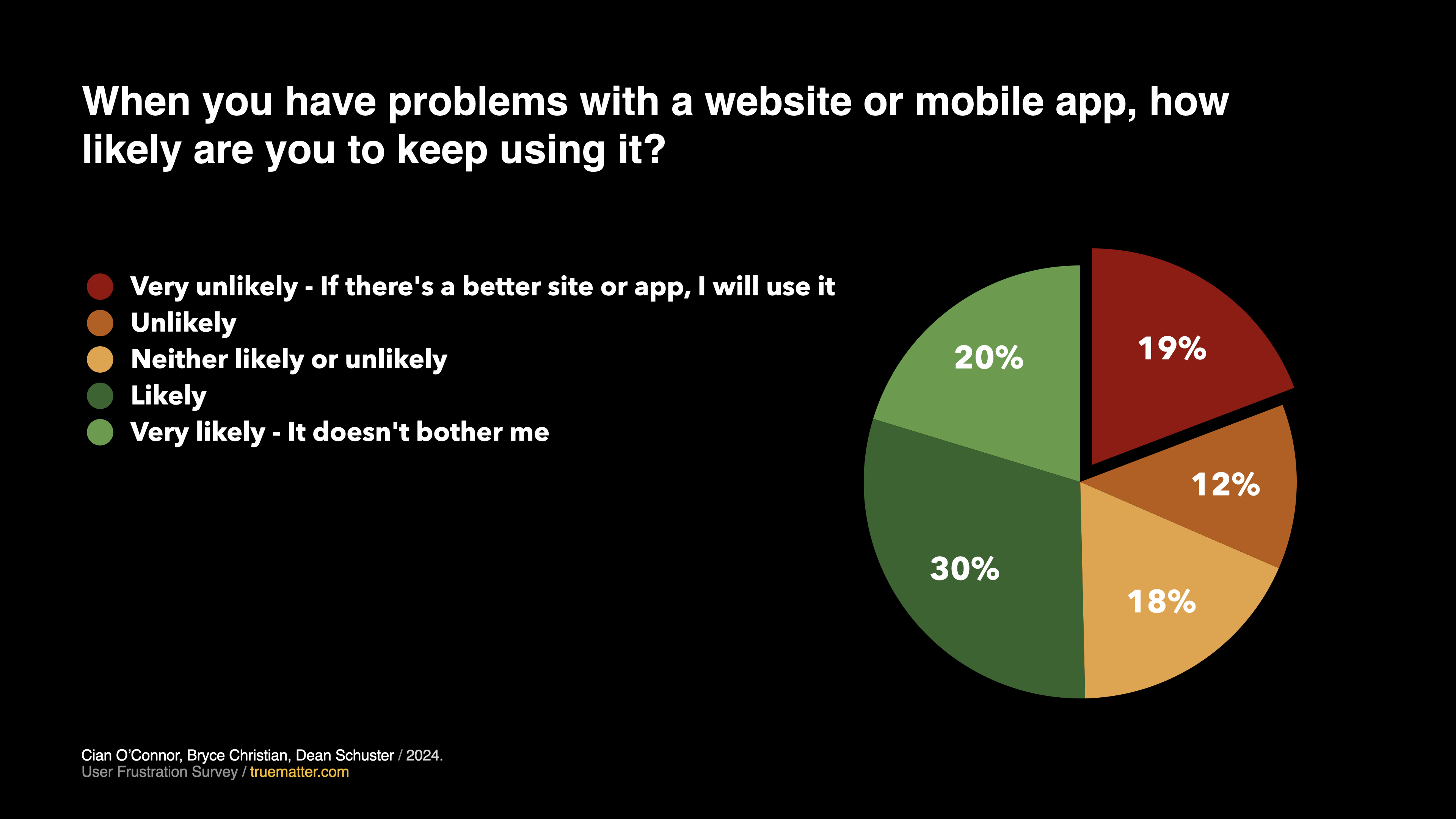
Roughly 30% of our respondents reported they would likely continue using a product even if it frustrated them regularly. Another 20% reported that irritation didn’t bother them enough to cease use. This means half of our respondents would simply continue using a product despite frustration.
Hertzeum and Hornbaek’s study focused more on single incident resolution than broader decisions about product use. They found that 74% of users resolved frustrating episodes. Apparently, people tend to push through problems, one way or another. That’s encouraging—until we consider the remaining 26% gave up entirely, an alarmingly huge number.
Our survey participants fared little better. If frustrated, 20% would stop using a product altogether. What other industry, apart from software development, would tolerate this depressing percentage? Organizations could be losing one in every five users for entirely preventable reasons.
Perseverance Despite Frustration
Why do some people wade through problems and even stick with frustrating products? Maybe they are the best of us. But perhaps, like everyone else, they have no choice.
Most common tasks these days are handled online. We pay bills, do taxes, fill out forms, file insurance claims, or use intranets at work. Often the sites, apps, or software we use are either completely necessary or even required.
If you get a parking ticket that can only be paid online, chances are you must use your government’s wholly inadequate, hard to use, badly designed, annoying site or app. You must complete your task, frustrating or not. Lack of choice is perhaps implied in the high percentages of people who push through frustration.
Breaking the Frustration Cycle
Sometimes it helps to have data that proves what we already know to be true: People are deeply frustrated by sites, apps, and software. That frustration has real consequences. Hertzum and Hornbaek’s academic study showed this. Our rapid-fire survey reinforced it, often quite closely.
The question remains. Now what?
First, let’s move on from the negative and understand what people really want.
What Delights People?
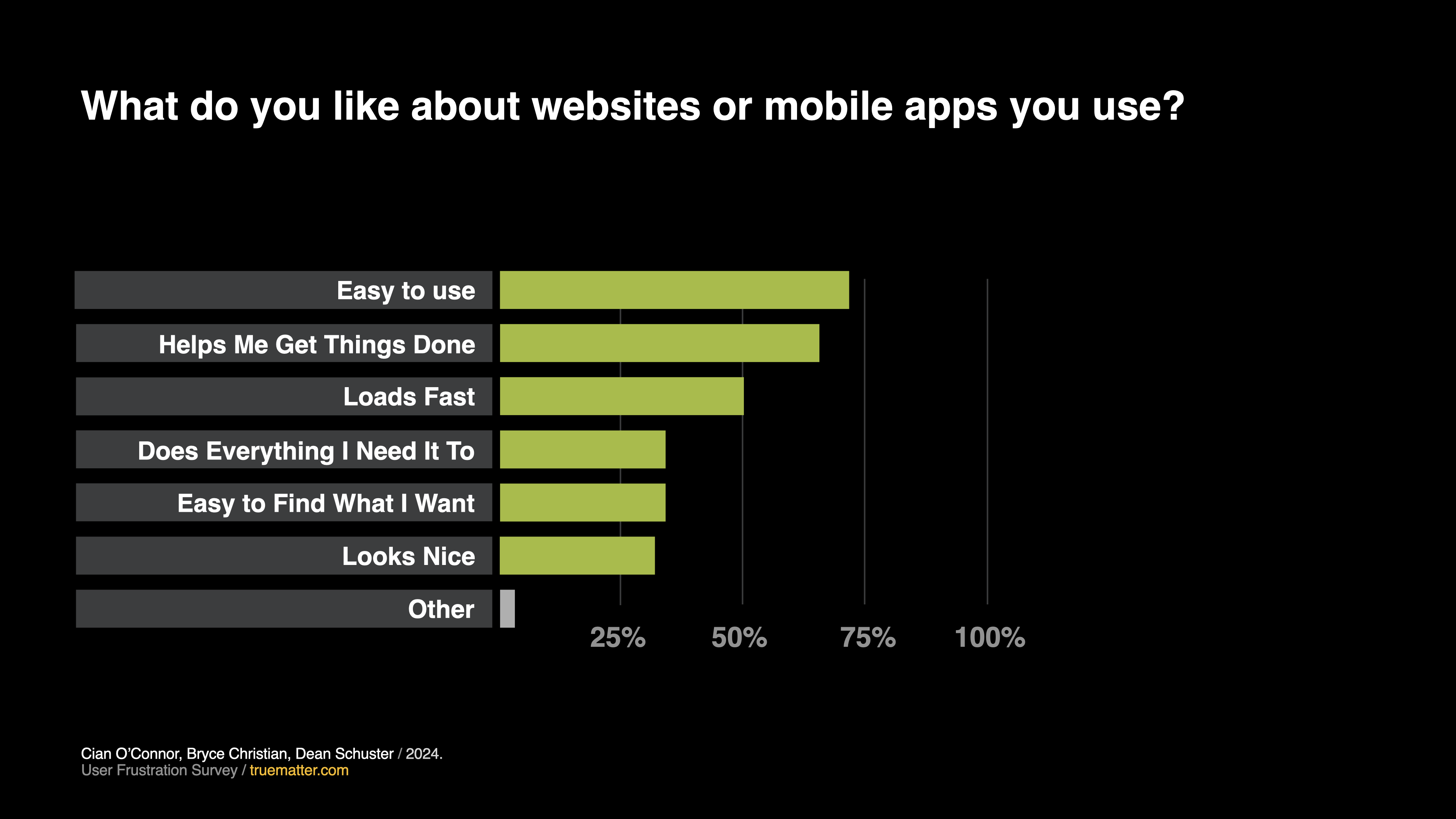
We asked our respondents what they appreciate about using interactive technology. As you might expect, they reported loving precisely the opposite of what they hate. People are pleased when digital products load quickly, are easy to use, and help them complete tasks without fuss. This is patently obvious and shouldn’t feel like much to ask.
Become a User Scientist
Knowing what people really want is the essential first step. But precisely how do you make your site, app, or software product less frustrating? You certainly won’t do it by making it “look nice.” And you won’t do it by popping in the latest AI assistant, either.
Many companies make digital products people love. If you are a leader or product owner, find out what they are doing right and dedicate yourself to these principles. You can change your organization from within.
The best way (we’d argue the only way) to truly improve your product’s usability is to get closer to your users. Much closer. Talk to them. Observe their behavior. Test your work with them. Make this a habit, and you’ll find reducing their frustration remarkably easy.
So, what are you waiting for?
---
Citations / Further Reading
User Frustration Study
Hertzum, M., & Hornbaek, K. (2023).
Frustration: Still a Common User Experience.
ACM Digital Library.
Video Option:
https://www.youtube.com/watch?v=JTR_E9nqvZQ
Supplemental Summary/Critique of the Study
Jakob Nielson. (2023).
UX Tigers
User Frustration: Frequency and Root Causes
On Becoming a User-Focused Organization
Truematter.
Organizations Doing UX Right Have These Things in Common

Written By Dean Schuster

Founder and Owner of truematter
Dean Schuster has been creating human-centered digital products since the beginning of the commercial web. He speaks and teaches user experience all over the world.